Is there money to be made in art?
My experience at art school shaping my existential reality of the art world and how to make money making art.
2/5/20264 min read
If you read my about section you'd know that I went to art school. Totally not making a big deal out of it, since in reality, I could have never gone to college to become a tattoo artist.
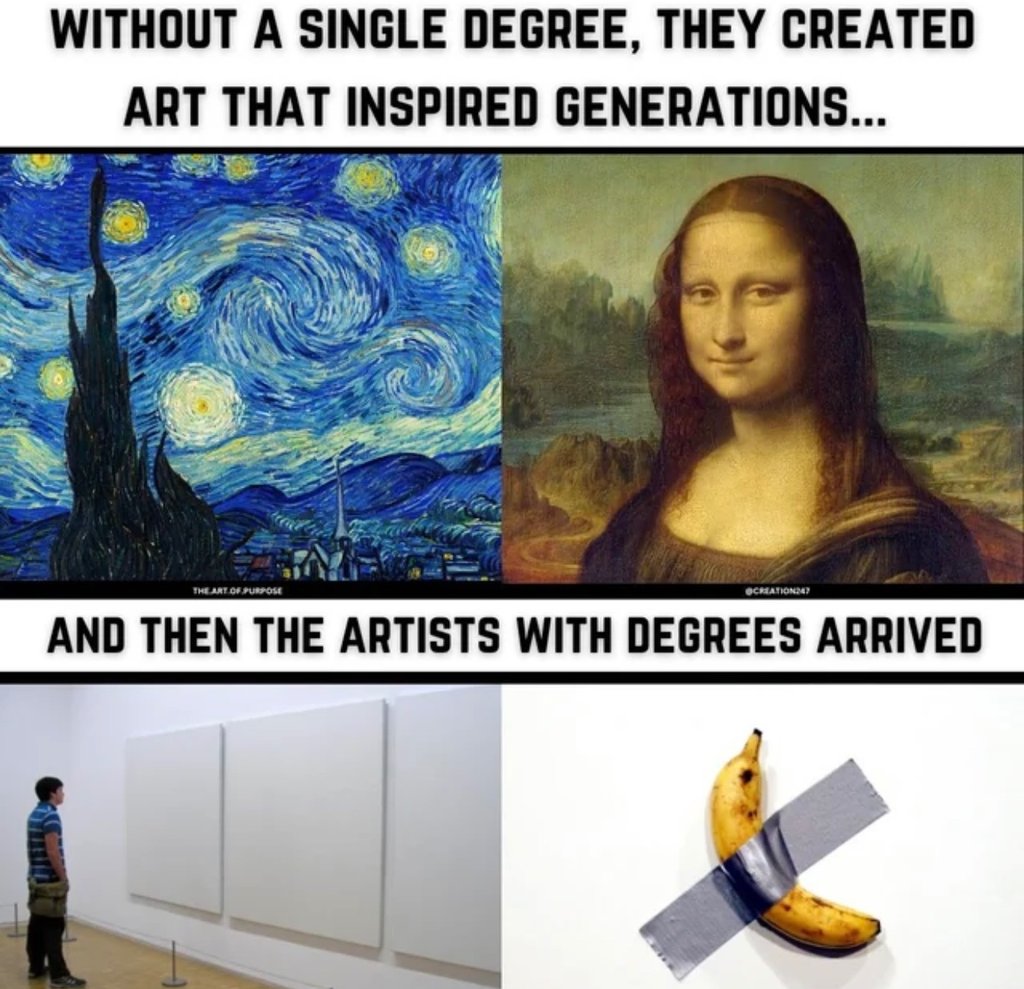
UCLA's program was very much a conceptual school, emphasis on making you think about the meaning/concept of your art; that was first and foremost before technique (as the meme illustrates). I got disinterested in art school because for one, deep down I knew my brain wasn't fully developed yet and I needed to go out and experience the world before I try to hustle my art and sell myself (who I didn't really know yet).
Being an artist that makes money requires more than just having an idea, or the skill to make something aesthetically pleasing. It is a consistent practice, a discipline, a mentality, a hustle, some luck, all together at once. Being an artist means you have the means and ability to inspire others with your work. But I am no gatekeeper.
There is a lot of money being moved around in the name of Art. I remember when I first questioned the high art world with a capital A. It started looking like a scam. Early 2000s, I went to an artist's warehouse space where the artist was creating "ready made" art works which consisted of a thousand dollars worth of eBay purchases (hookah hoses, cans, other junk), paying assistants $20 an hour to assemble the shelf of eBay items with no aesthetic appeal whatsoever, and then selling it for $15-20 thousand dollars. It is not an innovative concept, Duchamp beat him to it decades ago. I began to question the buyers, I was 18 and wondered how do they have so much money, and why are they spending it on mediocre art? Don't get me started on Thomas Kincaid.
I went to a David Hockney show in Venice while in college and loved his work. I walked around the exhibit, there were at least 30 paintings. I saw the price list at the gallery, and looked at it. I thought I saw $2,700.00 and so I walked back to the painting to see how big it was, and thought, that's strange, it's not a thumbnail, it's a decent size painting. I knew some graduate students that were selling their work for that much, so I walked over to the price list again, and realized my mind totally missed a zero at the end. It was $2,700,000.
For the artist you're in luck if fame and fortune finds you in this elite market without nepotism on your side. While you get to make art, the art itself gets to be the next charitable gain write off for the wealthy elite. Your work will miraculously appreciate in value as a gallery market flip, then it could get donated to a museum for an exponential price as a massive tax write off. Turns out the art world is an unregulated, exclusive system that functions as an investment vehicle and tax shelter for the wealthy elite. It's like having a bank account without a bank, especially when you know someone as wealthy or wealthier will buy it.
As the artist, it's like winning the lottery, high probability of never going to happen, but it definitely does happen. There are also artists that are funded through grants, residencies, scholarships and fellowships, which is great for that networking part required to possibly quantum leap into becoming the next "stock option" traded among elite galleries. In this realm, everyone has a certain amount of opportunity, capacity and luck, fated by our ancestors (more on that in the article on the way). Banksy is a good example of someone who had a good amount of all three, being discovered as once an anonymous street artist, then escalating into Sotheby's auctions for the uber wealthy. Someone writes about Banksy, that his work is "thought provoking", is that an attribute only Banksy art can produce? Why is it that other "thought provoking" low brow artists will never break through?
A painting of Frida Kahlo's sold for $35 million and I wonder if she would ever imagine that much money in her life? Hokusai's great wave sold for $88 million at a Sotheby's auction this year. Both of them are dead, and while they might have lived a decent life without money struggles, unlike Van Gogh, the exploitation of their art is just another day in the office of a wealthy elite's financial consultant. Not denying the exceptional talent of Frida Kahlo or Hokusai, but I wonder if they knew what would become of the business of high art and its core function for tax evasion and (likely) bragging rights.
Outside of the Art world, there are art businesses that are not as exclusive and most of the time (if not all) requires blood, sweat, and tears to become successful. There are tattoo artists, ceramicists, printmakers, muralists, sculptors, jewelers, photographers, it goes on and on, and the level of consistency of practice and discipline will hopefully pay off (not when you're dead). I call it, paying your dues. It's where you dedicate hours everyday on your art craft. Where nothing else matters because your livelihood depends on it. I'm no nepo baby, so I went back home after college to live with my parents during my tattoo apprenticeship. I moved out in January 2007 into my very own tiny 1 bed 1 bath for $550. Sometimes it took me 3-5 days to get that rent money, and I felt so proud of myself. It was the first step in being a working artist that could pay my rent. If you spend enough time and energy on something, as they say "if you build it, they will come." I will die on that hill but it's the emphasis on how you build it. Another saying I like, "it's not what you got, it's what you do with what you have".
Be intentional, be mindful, practice delayed gratification, set goals, surrounded yourself with aligned people, because you'll have less of a headache trying to navigate this highly competitive, capitalistic, morally corrupt world, because everybody's gotta eat, right?